
Germany's China crisis
The grim context for Chancellor Merz’s first official visit to Beijing

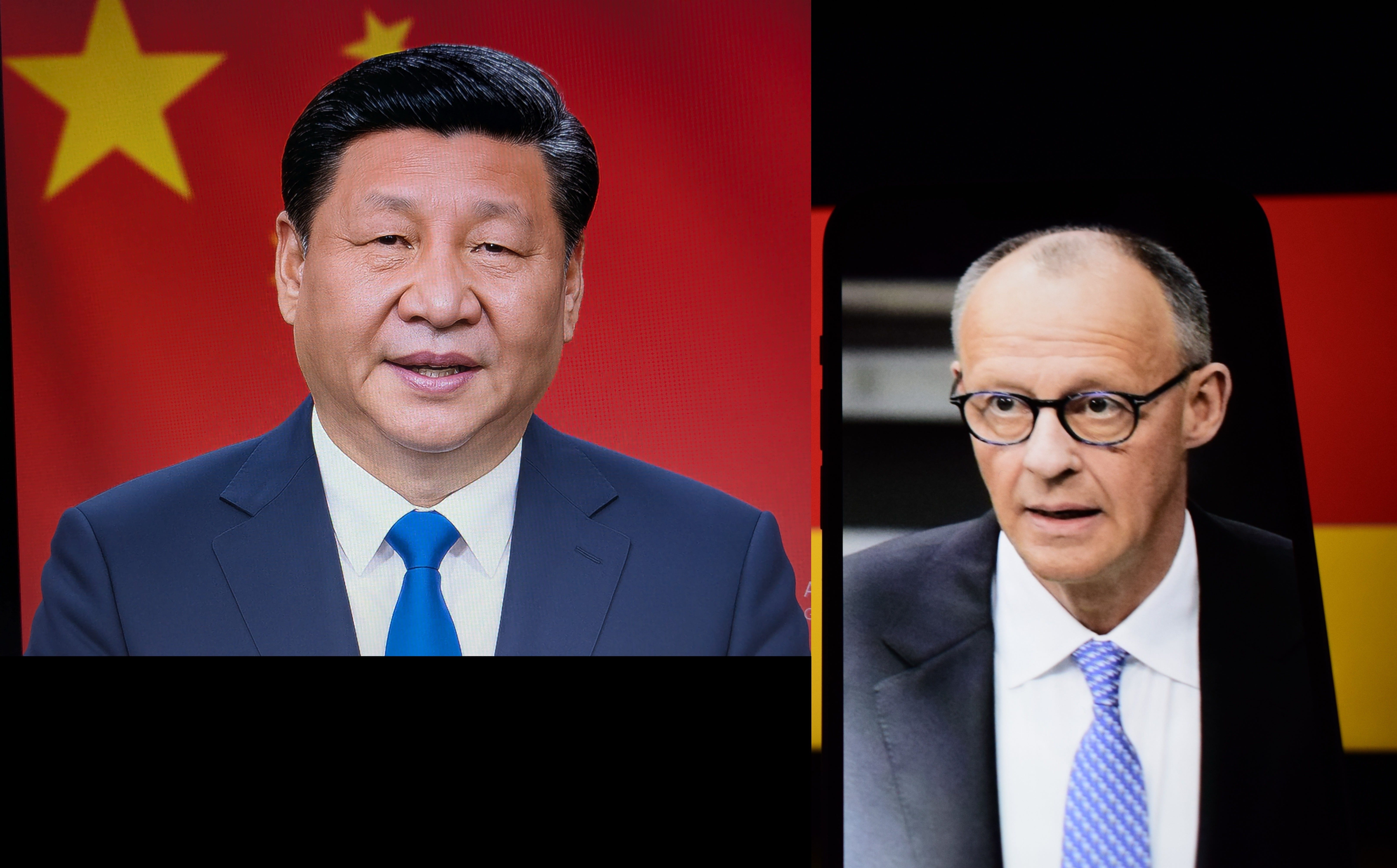
In December, I gave an interview to German business newspaper Handelsblatt about the challenges of dealing with an increasingly totalitarian and coercive Chinese Communist Party and the Second China Shock’s impact on Germany’s economy. Earlier this month, Munich’s Südedeutsche Zeitung also did a Q&A with me on those topics. This is the first of three posts expanding on those interviews to explain the existential crisis in Germany-China relations and offer solutions.
German Chancellor Friedrich Merz this week joins the procession of Western leaders making official visits to China while facing a dreierwette (trifecta) of aggressive imperialism from Russia, geopolitical uncertainty from “America First” and hegemonic mercantilism from the Chinese Communist Party. Call it the Zeitenwende on steroids. Here we look at that third fracturing industrial leg of the broken tripod that once ensured Germany’s prosperity and what the Chancellor needs to do in Beijing and Hangzhou this week.
Merz arrives in China as an Atlanticist Realist bound by security dependence on the U.S. and political dependence on key German businesses, which are themselves bound in dependence on China. He’s seeking to de-risk without rupture while hardening Europe’s posture through EU instruments, all while shepherding the largest German business delegation since Angela Merkel was chancellor. The itinerary includes the first bilateral industry forum since 2018, and the first bilateral dialogue forum for politicians and scholars since 2019. Despite this seemingly normal diplomacy, there will be elephantine problems in the room during these discussions.
BLUF: Germany’s industry is losing revenue and market share in China, being undercut by Chinese firms in third markets it once led in, and simultaneously becoming more dependent on Chinese inputs and raw materials. It’s a triple whammy, and there’s nowhere to go but down. Oh, and China’s also supporting Russia’s invasion of Ukraine and covert aggression toward Europe, which is costing Germans hundreds of billions of euros. Merz needs to fix all this or watch his country’s fortunes decline precipitously.
Last year China ran a breathtaking record $1.2 trillion trade surplus. Germany’s taking that surplus on the chin, and its geoeconomic plight is worse than most people realize. Europe’s once-mighty export titan is now in an economic mess. If you’re not familiar with the economics of the Second China Shock, my post below sums it up:

China is destroying Germany’s industry
Twenty years ago, I helped Daniel Rosen research an article titled “How China is Eating Mexico’s Lunch”. The PRC has spent the intervening decades moving up the value chain to feast on Germany’s dinner. Dan’s Rhodium Group has some painfully clear graphs illustrating what this looks like in a new note, “Germany’s ‘China Shock’ Revisited”.
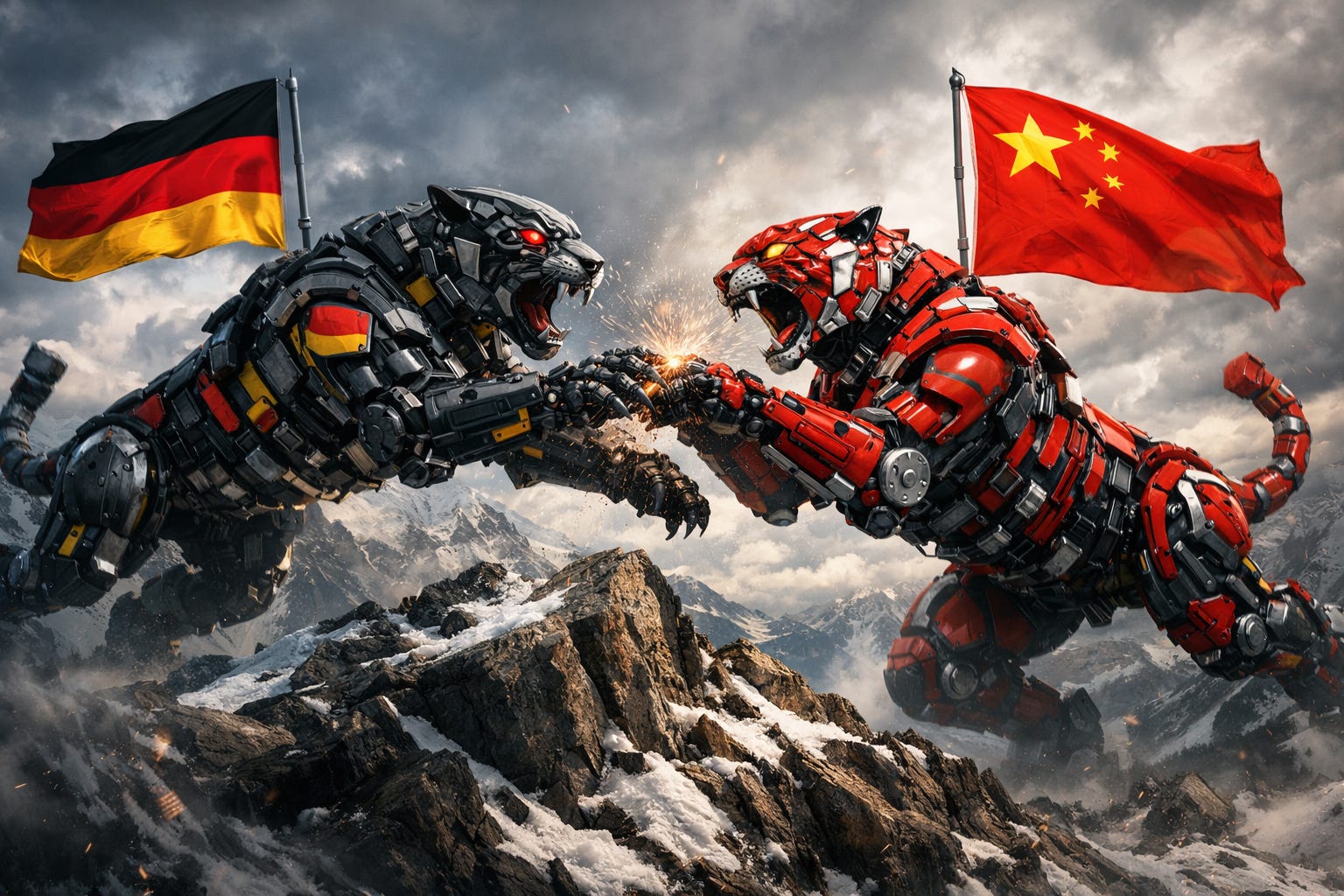
There’s an old Chinese saying that encapsulates the dynamic now: 一山不容二虎 (yì shān bù róng èr hǔ)—one mountain cannot accommodate two tigers. And the PRC wants Germany’s spot atop the industrial mountain.
Germany’s Federal Foreign Office describes China as the country’s most important trading partner, but that’s not necessarily a good thing. Simply put, Germany is buying far more from China than it’s selling. The country now runs a €90 billion trade deficit with the Middle Kingdom, which The Economist helpfully notes equals a “head-spinning 2% of German GDP.”
Germany has been running a goods trade deficit with China for well over a decade. A key inflection came in 2020 when two core industrial sectors, autos and machine tools, became net importers. Car exports plunged by nearly 70% between 2022 and 2024 as China’s domestic production ramped up, and last year, the German Economic Institute (IW) calculates, they fell a further 33% compared to 2024, while metals, machinery, electricals, pharmaceuticals, and chemicals all declined about 10%.
Meanwhile, China’s subsidized industrial goods and EVs are gutting German manufacturers in their own domestic and third-country markets. That’s coming at the expense of production in Germany, where auto worker layoffs are now running at rates steeper than during the 2008 financial crisis or the pandemic. Layoffs averaged at least 10,000 per month in 2025, Destatis data indicates. The engineering lobby, VDMA, reports that machinery sector employment fell 2.4% last year. Over 200,000 Germans have lost well-paid manufacturing jobs since 2019, GPPI Director Thorsten Benner notes, and with at least as many at risk.
This decline is not cyclical. Rhodium describes it as structural decoupling. Germany’s growth forecast for 2026 is under 1%. As a Bloomberg story recently put it, the country is “ground zero of the changing terms of trade with Beijing.”
China no longer wants German goods in the volumes it once did because it increasingly makes competing products itself, often better and cheaper, subsidized by the state on a scale that no private sector competitor can match.
While partly due to a natural process of Chinese companies climbing the manufacturing value chain, an artificially low yuan (renminbi) is also making Chinese exports cheaper, and imports pricier. The yuan has lost nearly 20% of its value against the euro in nominal terms since mid-2022 and roughly 8% in the past year alone, reducing the impact of EU tariffs and discouraging Chinese investment in Europe. European auto suppliers estimate they face a 35% cost disadvantage against Chinese competitors.
But most importantly, the Chinese Communist Party (CCP) has also been pursuing the biggest, costliest industrial policy in history, built on strategies including the Belt and Road Initiative, Made in China 2025, and Dual Circulation (making others more dependent on China, and China more self-reliant). It’s part of a techno-authoritarian drive to dominate the commanding heights of 21st-century production and geoeconomic power, and to achieve impregnable regime security and national greatness.
Some analysts have seen this coming. When the Party-state unveiled MiC2025 a decade ago, a commentary in Die Zeit dubbed it a declaration of war against Germany, while a detailed study by the Berlin-based Mercator Institute for Chinese Studies (MERICS) characterized it as a forceful challenge to leading economies. In 2019, the Federation of German Industries (BDI) bravely labelled China a “systemic competitor.” A year later a 2020 FDD report, citing original Chinese guidance, laid out the conflict: “Germany wants to maintain its leading position in manufacturing, and China wants to seize this leading position.” But Germany’s government and businesses remained complacent over the ensuing decade.
The Chinese are coming for Germany’s export markets, too. PRC state-subsidized manufacturers of cars, machinery, chemicals, green tech, and more are now competing directly with German firms in Southeast Asia, Latin America, the Middle East, and increasingly in Europe itself. With Trump’s tariff barriers diverting Chinese exports to Europe and other markets, the problem is only worsening.
This is what weaponized interdependence looks like. Germany depends on inputs from China, while China is weaning itself off German imports. German industry relies heavily on China for cobalt, rare earths, graphite, silicon, lithium, and a range of intermediate inputs, such as laptop components, printed circuit boards, and LEDs that it can’t rapidly replace. China controls roughly 80% of rare earth processing capacity globally and over 90% of magnet manufacturing. When the CCP weaponized rare earth and automotive chip exports in spring 2025 in a direct response to European actions it disliked, it wasn’t making an abstract point. It was demonstrating that it holds chokepoints in the supply chains that keep German factories running and German military rearmament on schedule. Berlin was practically mute in response. Pragmatism? More like capitulation.
As Rhodium notes, these problems are now compounded by the trade diversion caused by unusually high American tariffs. Last year China’s exports to the US dropped by nearly a fifth and rose for other markets.

Midnight for the Mittelstand: How bad could it get?
As one industry rep observed, it’s not five minutes to midnight, it’s already midnight. Looking further down the road, the scenarios range from serious to catastrophic. If current trends continue, in the near term Germany faces accelerating deindustrialization in core sectors such as automotive, chemicals and machinery. Expect firms that can no longer compete to close plants, relocate production to China to reduce costs, or simply disappear. Once a factory closes, it doesn’t come back. The institutional knowledge, the skilled workforce and the supplier ecosystem all dissolve.
In the medium term, Germany faces the prospect of being held permanently hostage to CCP political decisions. If Beijing can exert even more influence over the largest economy in Europe, it can further shift the balance of geoeconomic and geopolitical power. This is already happening in miniature. When Berlin in 2019 decided to ban Huawei from its mobile phone networks, Beijing threatened consequences for German automakers, and Germany blinked and then dithered for five years before announcing a phased plan. When Chinese authorities pushed VW on its Urumqi factory, which was operating in the middle of one of the worst human rights situations in the world, the company stayed, and the German government said nothing meaningful. Corporate overexposure has already corrupted German foreign policy. At some threshold of dependency, that capture becomes irreversible.
The worst-case scenario, however, involves Taiwan. Xi Jinping has tasked the People’s Liberation Army to develop the military capability to force unification by 2027. That means war is a scenario for which any serious government and multinational company must plan. Germany shows no sign of having done so. A military conflict in the Taiwan Strait, or even a serious blockade, would trigger Western sanctions against China and potentially cut off German companies’ China assets entirely. The €89 billion in German direct investment in China would be at acute risk. Supply chain disruption across multiple critical industries would follow immediately. Germany’s existing bilateral investment protections would provide no meaningful coverage. A hard decoupling under those conditions would destroy entire German value chains and precipitate a deep recession.
Worst of all, Germans don’t know how exposed they are. Supply chain mapping remains incomplete. Outbound investment screening doesn’t exist. The national economic security strategy promised for 2025 remains unfinished. Germany can’t make good decisions about a vulnerability it hasn’t accurately measured.
The PRC makes no secret of its framework: a Shenzhen news commentator last week observed that “security determines trade, and trade, in turn, influences security.” Xi himself has stated explicitly that China should “increase the dependence of international supply chains on China and establish powerful retaliatory and deterrent capabilities against foreign powers that would try to cut supplies.” That’s China’s geoeconomic strategy. The question is whether Germany and the EU treat it as such, or continue to discover, shock by shock, concession after concession, that they’ve been outplayed by a Leninist Party-state that started thinking about this long before they did.
How Germans built the trap they’re caught in
In a recent essay that’s essential reading, Thorsten Benner pulls no punches:
“Over the past 15 years, Germany has recklessly maneuvered itself into a position of weakness and vulnerability to blackmail vis-à-vis Beijing’s authoritarian state capitalism.”
Germany likes to think of itself as a serious country. It has world-class engineering, a tradition of industrial innovation, and a political culture shaped by hard lessons about the dangers of appeasement. So how did it become the Western democracy most thoroughly enmeshed with—and most paralyzed by—the most systematically coercive authoritarian power of our era?
Here’s how. Successive German governments chose trade over strategy. Under Kohl, Schröder, Merkel, and Scholz, a single organizing principle governed Germany’s approach to China: keep the factories humming. Wandel durch handel (”rapprochement through interweaving”) was a business model pretending to be a foreign policy.
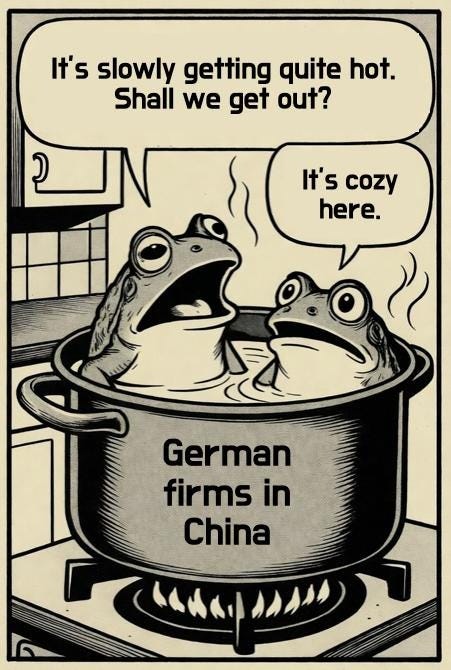
Germany’s China problem is structural. BASF, BMW, Mercedes, Volkswagen, and many of the other DAX-listed companies whose CEOs are joining Merz in China this week account for a disproportionate share of Germany’s export earnings and political weight. As BASF opened a €10 billion facility in China, it simultaneously announced it was “permanently downsizing” in Europe. VW’s former CEO put it bluntly: China probably doesn’t need VW, but VW needs China a lot. The economic consequences are now undeniable.
Unlike Merz’s predecessors, he’s acknowledged the risks from Chinese overcapacities and signalled openness to trade barriers and local content rules. That’s progress, but it’s not policy. In his first months in office, China got lost in the shuffle of Ukraine, transatlantic turbulence, and Germany’s economic stagnation.
There’s a deeper problem lurking beneath the economic one: Germany has never fully developed a strategic culture adequate for dealing with authoritarian powers. This is the country that pressed forward with Nord Stream 2, a gas pipeline from Russia, years after Putin’s 2014 annexation of parts of Ukraine. Until 2022, it was considered an “unpolitical, economic problem,” as if the two could be separated when dealing with Moscow. The same habits of mind still shape how German elites approach China. Strategy is treated as somebody else’s job. The instinct is to outsource serious problems to Brussels. Germany now finds itself at the centre of Europe’s most consequential foreign policy challenge, lacking the intellectual or institutional tools to address it.
CCP plays the corporatist state like an accordion

The German elite built its identity, career success, and understanding of national prosperity on a model that no longer works—but that it’s psychologically averse to abandoning. Through decades of export promotion, investment guarantees, diplomatic cover, and the political normalization of its China exposure, the German state actively built this dependency. It encouraged German firms to invest in China. It made VW’s China revenue politically essential to Germany’s growth statistics. And so, tragically, the liabilities of German business in China have become an intractable problem for the German state, not just for the firms themselves.
Last year German companies invested around €7 billion in China, IW assesses based on Bundesbank data, above the annual average of €6 billion from 2010-2024. The institute says the two main drivers are Chinese industrial policies that induce firms to produce in China for China, and lower costs that enable global competitiveness. Nobody else is doing that right now. That serves the interests of nominally German companies, but not the German people or their country. German firms aren’t the only ones to invest in China of course, but they’re outliers in degree and absolute volume, the concentration of their dependence in systemically important sectors, and their persistent investing despite mounting geopolitical risks and private government entreaties to dial back.
Why hasn’t Berlin stopped this? Because Germany is a liberal corporatist state. German companies lobby the government to make policy that promotes their interests, and in return, they help politicians maximize growth and employment levels, which are the currency of political survival in German electoral politics. It’s the system’s operating logic, in a way that’s different from that of other Western countries. BASF and the big carmakers are considered so systemically important that they receive implicit state guarantees. There’s also the organized lobbying power of the Asia-Pacific Committee of German Business.
By creating the conditions under which German multinationals became dependent on Chinese market access, Beijing acquired leverage not merely over those companies but over the German state itself.
Supply chains for fools
As Germany’s multinationals localized in China, they pulled their entire supplier ecosystems with them. Bosch alone employs 60,000 people in the PRC. The mid-sized companies and suppliers that built their businesses around contracts with VW, BMW, and the rest became structurally dependent on those OEMs’ China revenues. When VW succeeded in China, the orders flowed back through hundreds of Mittelstand suppliers across Germany. When VW started losing in China, those same suppliers felt it, but they also knew that any policy that damages VW risks destroying the orders they depend on even more.
Making China policy a decisive electoral issue would require building a coalition around a diffuse, technical and long-term threat. By contrast, the political costs are up-front. Opposition is starting to cohere, but it’s arrived late, remains fractured, and faces structural obstacles that make effective collective action difficult even when the political will exists.
Even where opposition has organized, it can’t speak with a unified voice. The evidence from the “Made in Europe” debate is instructive. CLEPA, the European auto suppliers’ association, has backed local content requirements and published detailed data showing a 35% cost disadvantage against Chinese competitors. The VDMA, representing German machinery manufacturers, demanded stronger market protection last year, but then this year called local content rules a distraction. More than 1,100 European executives, including Bosch and Continental, signed a public letter supporting “Made in Europe” requirements. But the VDA—which nominally represents the whole automotive industry—has opposed local content rules as bureaucracy, because it speaks first for the OEMs. And even within the multinationals, the coalition has fractured: Volkswagen recently joined a European coalition supporting a “Made in Europe” strategy while BMW actively opposes it.
Industry is split. Companies that manufacture predominantly in Germany want protection. Companies that have invested heavily in China and are pursuing their own “Made in China” strategies see protective measures as obstacles to their outsourcing. Consider that a VDA survey from January 2026 found that 72% of small and medium-sized auto component suppliers plan to cut investments in Germany, and 28% plan to move operations abroad. These are not the multinationals. These are exactly the companies one might expect to lead the opposition. Instead, pulled by industrial gravity, they’re following the multinationals’ relocation logic, embedding themselves deeper into Chinese supply chains because that’s where the production is migrating. The opponent and the protector are, for many of them, the same entity.
Despite Merz’s tougher talk, in January Germany relaunched EV subsidies to the tune of €3 billion without local content requirements, so they include cars made in China, including Chinese brands. Looks worryingly like a signal the Chancellor has quietly picked a side in this debate.
Unionized corporate hostages
In theory, organized labour should be the most powerful vehicle for worker-led opposition. But it has been a systematic obstacle for decades. IG Metall, Germany’s largest and most influential industrial union, spent years actively defending the China status quo because China revenues meant German jobs. The chairman of IG Metall sat on VW’s supervisory board. When VW’s Urumqi plant became a human rights scandal, IG Metall’s response was to ask cautiously what it “means for the company’s reputation”—not to demand withdrawal. The union’s leadership understood that taking an adversarial position on China exposure risked threatening the employment base on which their entire organizational identity was built to protect. I’d call that a corporate hostage situation.
A shift has begun. In July 2025, IG Metall held a closed-door discussion that asked “Is Germany Facing a China Shock?” (spoiler alert: yes) and warned of deindustrialization, but by then the job losses were already mounting. For the crucial period when policy choices still offered real leverage, organized labour worsened the problem. And now that window has closed.
Corporate Germany’s collective action dilemma
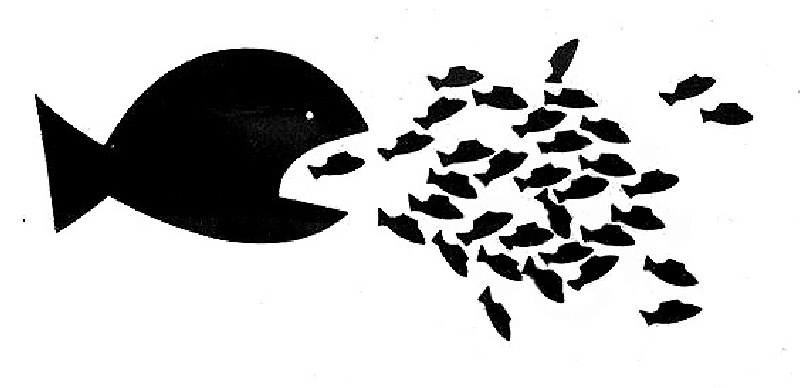
Yet another problem is the classic collective action difficulty that political scientists have studied for decades. Large concentrated interests such as VW, BMW and BASF have every incentive to invest heavily in lobbying because the policy decisions in question directly and measurably affect their bottom line. They know what they want, they have the resources to pursue it, and the causal chain between policy change and corporate impact is direct and legible to their leadership.
Small and medium-sized enterprises face the opposite structure. Their individual stake in any given policy decision is real but diffuse. Organizing requires identifying and communicating a shared interest across thousands of firms in different sectors, with different exposure to China, different supplier relationships, and different political connections. The cost of organizing exceeds the expected individual benefit for any single firm, even if the collective benefit would be enormous. This is the textbook free-rider problem, and it systematically advantages the large incumbent players in any lobbying environment.
The economic benefits of the China relationship are increasingly fictitious in their distribution. The profits flow to a handful of large multinationals. The costs—energy bills, tax-funded emergency subsidies, lost industrial competitiveness, and defence spending—are socialized across all German taxpayers and workers. Germany’s corporatist structure means that a small number of firms with concentrated Chinese exposure effectively set the terms of the national debate, while the broader German public pays the price.
There’s a related temporal mismatch. The costs of Chinese competition—lost contracts, eroded margins and slower growth—accumulate gradually and diffusely across many firms. The benefits of accommodation—securing orders, maintaining market access and avoiding retaliation—accrue visibly and immediately to the multinationals and their suppliers. Politicians respond to what’s salient and legible in their constituencies. A VW plant closure is salient. A thousand SMEs each losing 15% of their revenue to Chinese competition over three years is real but electorally invisible until it reaches crisis level.
China and Germany: codependent mercantilists

There’s one final dimension that explains something important about why the framing of this debate has not shifted faster. Like the PRC, Germany has a mercantilist, producer-oriented political economy in which corporations’ interests are systematically privileged over those of consumers. The ‘ordoliberal’ tradition, which shapes German economic governance, is deeply skeptical of protective industrial policy, equating market intervention with distortion. Many of the German actors who are most intellectually opposed to accommodating Beijing are also ideologically uncomfortable with the protective measures that effective pushback would require. The argument for “Made in Europe” requirements or targeted tariffs runs against the instincts of a political establishment that has spent decades preaching free markets.
The CCP, which as an apprentice learned some of its mercantilism from watching Germany, has exploited this contradiction. Now the apprentice has become the master. It presents itself as a champion of free trade and globalization, and Germany’s Pavlovian ordoliberal reflex makes it drool in response to that framing, even as actual PRC behaviour is the opposite. Calling things by their correct names—identifying China’s industrial policy as aggressive mercantilism backed by state power, not market competition—would require a cognitive paradigm shift in how German elites understand their economy and reconcile their own contradictions.
That shift is now underway, driven by the sheer scale of the losses. The CLEPA data, the IG Metall discussions, the Bundesbank president’s call for a more “offensive” response, the BDI’s own critical assessments, all represent a genuine, if belated, mobilization of the interests that should have organized far earlier. What remains to be seen is whether this awakening arrives in time to shape policy before the structural opportunity to do so has passed. Industrial ecosystems, once relocated, do not return. Technological gaps, once opened, widen rather than close. The window for effective counter-organization is narrower today than it was five years ago, and it narrows further with every investment decision made in Zhengzhou rather than Stuttgart.
The trouble is that like many democratic publics, Germans tend to prioritize short‐term benefits over long‐term ones, and are averse to short-term costs. Merz’s incentive in visiting China is to secure immediate benefits for voters and corporate interests. Changing those incentives would require altering Germany’s institutions and procedures, with things like youth quotas for voting and official representatives of future generations.
How the CCP views Merz and will try to use him

The CCP does not approach a visiting Western leader the way Western leaders approach each other. It does not ask what they want to discuss. It asks what they need, what they fear, what they can deliver domestically, and how pliable they are likely to be under pressure and inducement. By the time Merz landed in China, Beijing would have done extensive homework on all four questions. The answers, from the Party’s perspective, were probably encouraging.
Start with how Xi’s apparatus reads Merz the politician. He’s a conservative CDU chancellor who came to power promising economic renewal after years of stagnation under Olaf Scholz. He talks tougher on China than his predecessors, and his officials have vocally distanced the visit from the “reset” framing of Mark Carney and Keir Starmer, insisting it’s not that kind of trip. Beijing will note all of this, and discount most of it. The CCP has watched a long line of Western politicians arrive with firm rhetoric and leave with softened positions. It has watched Germany specifically for decades, and it understands the structural elements of German politics that we’ve discussed above and that Merz cannot easily escape. The 30 corporate bigwigs with Merz are not a negotiating chip for him, they’re a constraint, and Beijing knows it.
The Party’s assessment of Merz will combine respect for his tougher instincts with a calculated conviction that those instincts can be managed. He is not Merkel, who built an entire governing philosophy around commercial engagement with China and resisted costs to that relationship. But he has also not translated his rhetorical shift into concrete policy. Nine months in office and Germany still lacks outbound investment screening, a completed national economic security strategy, and a comprehensive supply chain dependency map. Beijing reads that gap between tough talk and policy inaction as exploitable space.
What does Beijing want from this visit? Several things, and they operate on different levels simultaneously.
1. Narrative control. The Party’s Propaganda Department has been methodically building a story throughout 2025 and into 2026: a sequence of Western leaders making pilgrimages to Beijing signals the rules-based order’s principal defenders are recalibrating toward accommodation, and that this vindicates China’s long-held position that multipolar pragmatism is replacing American-led alliance solidarity. German officials are acutely aware of this and have explicitly warned against it. One senior German official told Noah Barkin that China’s ultimate objective is “to portray the sequence of recent visits as a rejection of the US and a recognition of China as a guarantor of stability.” That awareness is itself significant. But awareness is not the same as immunity. The choreography provides Beijing with abundant raw material for the narrative it wants to tell, regardless of what is said in the meeting rooms. The photographs will be selected for effect. State media will parse the communiqués for any phrasing that can be amplified as validation.
2. Further fracture European and transatlantic cohesion on China policy. It will do that by demonstrating that Germany, the member state whose position most determines European China strategy, is willing to engage bilaterally on terms that diverge from Brussels. All the EU’s new trade defence tools require German political will to function. If Merz returns from Beijing with a softened posture on issues such as EVs and “Made in Europe” provisions, it will ripple through Brussels. Beijing understands this leverage precisely and has spent years cultivating it.
3. The FTA gambit. In a transparent wedge tactic, China floated the idea of an EU-China free trade agreement ahead of the visit. The pitch is designed to play to Germany’s export-dependent instincts, to create the impression of Chinese generosity and goodwill just as Merz arrives, and to put Berlin in an awkward position relative to Brussels. German officials have already indicated they will decline it, along with MOUs on the revival of the Comprehensive Agreement on Investment (CAI) and the PRC’s Global Governance Initiative. But declining something at the table requires a clearer and more decisive “no” than not being asked at all. Beijing will use the offer as an atmosphere-setter and a test: how does Merz say no, how firmly, and does the rejection come with any conditionality that can be worked with later?

4. Advance China’s position on the export controls standoff. Despite nominal “general licenses,” Chinese exporters are still delivering only 30% of what German companies under license actually need. This is deliberately maintaining pressure and the ability to inflict economic pain on German industry through supply chain chokepoints. The CCP wants Merz to feel this, while offering the prospect of relief if the relationship is managed to China’s satisfaction. Beijing has incorporated Berlin’s relative silence on rare earths last year into its assessment of its leverage and the credibility of German threats of countermeasures.
5. Exploit the timing. Merz arrives in the week before the Party-state’s Lianghui (Two Sessions) during which it will adopt the next Five-Year Plan. That plan will continue the CCP’s industrial policy escalation by doubling down on the subsidized, state-directed production policies that are crushing German industry. By hosting Merz in this window, Beijing creates the impression of cooperative dialogue while simultaneously locking in the next phase of its industrial dominance strategy. The atmospherics of the visit will be used to blunt European criticism of that strategy: how can Brussels object to Chinese overcapacity policy too aggressively when the German chancellor has just finished a cordial bilateral forum with Chinese CEOs?
6. Further co-opt the CEOs. The CCP is extremely skilled at co-opting members of the Davos set of global business and financial elites. Merz is not a Davos Man in the Carney mold, but he is embedded in a political system that’s deeply penetrated by corporate interests with massive China exposure. The 30-company delegation traveling with him represents exactly the constituency through which Beijing has historically shaped German China policy from the inside. Even if Merz himself maintains rhetorical discipline, every CEO in that delegation has interests that point toward accommodation. Beijing will work that room deliberately, offering targeted reassurances, hinting at regulatory relief, quietly signalling the market opportunities that could flow to cooperative firms. The purpose is not to corrupt Merz directly, but rather to multiply the domestic German voices urging him toward moderation when he returns home. The message is warmth gets results, distance is futile.
The deeper strategic logic is consistent with how the CCP approaches all interactions with Western leaders: it wants to condition submission incrementally. It doesn’t need Merz to capitulate visibly. It needs him to return without having imposed new costs on China’s behaviour, without having committed to concrete EU-level de-risking measures, and with his business delegation’s drool reflex for Chinese market access intact and reinforced. If the visit produces that outcome, with a warm photograph, a vague communiqué, and no new policy architecture, the Party-state will notch up a win regardless of what was said in the closed-door meetings.
Merz’s own officials know this. The question is whether their awareness translates into the discipline required to deny Beijing the visit it wants while still conducting the engagement Germany needs. Xi respects toughness and tests for it. How Merz handles the 48 hours of this trip will tell Beijing a great deal about whether the new German government is a constraint it must work around, or European door it can continue to keep open.
Does Merz understand the CCP?

Just before departing Berlin Feb. 24, Merz said he planned to discuss thorny topics including overcapacity, export restrictions, competitive “distortions” and de-risking supply chains, and to warn his hosts that if they don’t take action to curb them, the EU will. The Financial Times also reported he intentionally visited India first before travelling to China to signal intent to reduce dependence. He’s also warned of the risks of investing in China. A longtime free trade advocate, he pivoted to support trade barriers on steel last November.
In a new essay for Foreign Affairs, “How to Avert the Tragedy of Great-Power Politics”, Merz himself writes that China has “been laying the foundations for influence over world affairs for decades. China systematically cultivates dependencies and is reinterpreting the international order.” Speaking of great powers in general, he notes “they exploit the dependencies of others and take advantage of them if necessary. Raw materials, technologies, and supply chains thus become instruments of power” in a “struggle for spheres of influence, dependencies, and allegiances.” There is the music of the Zeitenwende in his words.
Merz writes of “updating” Germany’s relationship with China and managing it “in a more mature fashion,” which I hope is not just a German echo of Starmer’s “more sophisticated relationship” bafflegab. The trouble with such phrasing is that aside from assuring they’ll do a better job than their predecessors, such words can mean anything the speaker later wants. The EU’s economic security strategy employs a “protect, promote, and partner” framework. But while French President Emmanuel Macron has underlined the “protect” part, the Chancellor worryingly still seems keen to promote and partner.
More encouragingly, Merz does pledge to “further de-risk by reducing dependencies,” “work hard to ensure fair competition and level playing fields,” and “shape a more united European approach.” All of that is absolutely necessary. He also shares my preferred framework of “principled realism” for handling relations with Beijing. Sehr gut.
Merz also seems to be aware of the security threat the CCP poses, if not of China’s history. Last week, he told (video in German) a Christian Democratic Union political rally in Trier, “China, in a complete departure from the last 3,000 years of Chinese history, is aggressively expanding its naval bases in the South China Sea, encircling Taiwan and openly declaring that it would be prepared, if necessary, to use military force to bring about the so-called reunification of China.”
Vice Chancellor and Finance Minister Lars Klingbeil‘s November visit to China mainly “resulted in some unenforceable promises on the continued flow of rare-earth mineral exports,” Bloomberg reported, further illustrating Berlin’s lack of leverage, even with the EU behind it. Foreign Minister Johann Wadephul followed with a postponed visit in December. The foreign minister has notably characterized China’s South China Sea behaviour as “increasingly aggressive” and criticized the CCP’s attempts to unilaterally change the status quo in the Taiwan Strait. In Beijing, unlike his British and Canadian counterparts, he seemed uncomfortable with optics that might imply normalization. Instead he accepted friction and rivalry as structural, publicly insisting on reciprocity in the relationship. We might characterize his stance as guarded engagement: keeping channels open as a means of containing fallout, while signalling Germany will continue trying to de-risk. The CCP tried to impose a binary choice on both visiting ministers: cooperation or confrontation, while implying that even the dour Germans had to come and talk with the Chinese.
We can hope Merz understands China’s strategic narrative and will counter with his own.
What the Chancellor should do in China

The key question for Herr Merz is what kind of chancellor he wants to be remembered as: one who finally told Xi Jinping the truth about the unacceptable state of the relationship, or one who flew to China with thirty business executives and came home with a communiqué and a problem he didn’t solve. The stakes are high enough to warrant directness. Germany’s not in a strong position, and PRC negotiation strategy will exploit that. If Merz walks into those rooms as a supplicant focused on getting German companies market access they once took for granted, he’ll leave weaker than he arrived.
Here’s what a serious visit would prioritize:
1. Flat-out reject an FTA. The proposed China-EU free trade agreement is a defensive maneuver. The Party-state wants to lock EU markets open at a moment when Brussels is debating local content rules, cybersecurity restrictions, and other measures that would limit PRC access to critical sectors. An FTA would bypass those defences and indeed bypass the European Commission entirely, which is what Beijing wants. Merz should close the door on this proposal in Beijing, not hedge it. The CCP will read any ambiguity as an opening to press harder.
2. Put the trade imbalance front and centre, with numbers and consequences. If those facts don’t feature prominently in Merz’s closed-door sessions with Xi and Premier Li Qiang, as conditions that China must address concrete remedies or face EU trade barriers, then he might as well have stayed home.
3. Don’t make the business delegation the story. Arriving with 30 bosses sends a message before Merz opens his mouth: Germany needs China. That may be true in the short term, but it’s not the signal a chancellor trying to rebalance a dependent relationship should be leading with. German multinationals want to deepen their dependence on China. But their interests diverge from Germany’s strategic interests, and Merz needs to be explicit about that distinction, both in Beijing and at home. The old model, in which German corporate lobbying effectively set China policy, has to end. Merz should take Carney’s experience as a cautionary tale, maintain guarded distance, and avoid imagery and messaging that imply full normalization.
4. Hold the line on the Party-state’s unacceptable behaviour on Ukraine, Taiwan, and Japan. Xi will raise the issues of Taiwan and Japan’s prime minister (who, in November, said a PRC attack on Taiwan could constitute “a survival-threatening situation” for Tokyo, requiring the use of force, and prompted the CCP to have a raging hissy-fit that continues to this day). Merz should restate the EU position firmly: any change to the status quo must be peaceful and consensual, and the disruption of trade routes through the Taiwan Strait or access to Taiwan’s semiconductor production would be catastrophic for Germany and Europe, and indeed for Japan. That’s just economic reality. Meanwhile, Merz should not soften that line in exchange for promises of rare-earth exports or market access. Such pledges have a spotty track record. The Chancellor should prioritize alliance cohesion and deterrence over economic accommodation.
5. Coordinated EU and likeminded messaging on human rights. Every institutional representative and significant minister visiting Beijing should carry a consistent script covering economic, security, and human rights issues together—not human rights as a diplomatic afterthought raised after the real business is concluded, but integrated throughout. This matters because the Chinese government’s treatment of minorities, dissidents, Hong Kong citizens, and Taiwan is not part of a separate category from its behaviour toward Western democracies and neighbours. It’s an expression of the same underlying pathology. The willingness to use coercion and repression domestically is mirrored in transnational repression and thuggish geopolitical conduct. Consistent collective signalling makes that connection explicit and is harder for Beijing to penalize selectively than isolated statements from individual governments, which it can reward or punish one by one until silence becomes the path of least resistance. The issue is not volume—what critics unfairly stigmatize as “megaphone diplomacy”—but consistency and coordination.
Messaging without consequences is theatre. There must be a legible correlation between what Beijing does and what European governments are willing or unwilling to do in response: if specific coercive measures remain in place, deeper cooperation should not proceed. Those linkages can be conveyed discreetly rather than publicly, but they must be real, and they must be maintained. The most effective approach combines this conditionality with targeted, concrete demands on specific individual cases, for specific policy changes, with measurable outcomes, rather than broad declarations about human rights in the abstract. Targeted demands are harder to deflect with rhetorical counter-narratives and “whataboutism” and their resolution or non-resolution provides an honest test of whether dialogue is actually yielding results.
6. Raise the weaponization of rare earths as a red line. When the Party-state imposed export controls on rare earths and automotive chips last spring, Germany’s faint response was a strategic error. If Merz doesn’t make clear in Beijing that a repeat of that coercion will carry real costs, in the form of coordinated EU countermeasures, accelerated supply chain diversification, and active support for critical minerals projects elsewhere, then he’ll implicitly confirm Germany can be bullied without consequences. More coercion will follow.
7. Don’t return without a commitment to concrete action at home. Germany still has no outbound investment screening mechanism. It hasn’t mapped its supply chain dependencies comprehensively. Its national economic security strategy, promised for 2025, remains unfinished. These aren’t abstract policy concerns; they’re the foundations of strategic autonomy.
The temptation on a trip like this is to perform: to demonstrate statesmanship, signal seriousness, and return with something that can be announced as a success. Party-state officials are masters at presenting that kind of surface without substance. Foreign Minister Wadephul was right when he said that Trump’s tariff offensive changes nothing about Germany’s China problem: “China is still the same country, and the risks to our economy are the same.” That clarity needs to survive contact with Xi Jinping’s hospitality.
Germany has spent thirty years running its China relationship on autopilot. This visit is a chance to seize the controls. Whether Merz uses it that way is the only question that matters.
With assistance from StrategicEffects’ Patricia Xavier, Joseph Widacki and Helen Lee. Andreas Fulda’s book Germany and China was particularly useful for research. Next week, Part 2 looks at how Merz did in China and what Germany and the EU should do next. Thanks for reading. Comments welcome.
Thank you for such a clear, well articulated article.
You show plainly how China's ability to plan and execute over long timelines have allowed them to maneuver into the strong position they are in.
I am worried that the West collectively isn't appreciating how significant the situation is, and how far behind we are. Even Trump who clearly made everyone take note of China's position in his first term isn't truly appreciating this.
I hope there are back channel dialogues happening between Canada, EU countries, Australia and America with other like minded nations to plan and execute better to decouple. Otherwise, in a decade, we'll all be entirely dependent on China for critical economic inputs without which our economies won't function.
One other aspect that is serious German risk is the jockeying for position for assembling China EVs in Europe. Countries like Spain, Hungary and Austria are all trying to take that business. Germany might lose their automotive role entirely.