
China-Canada relations: high tariffs and low trust
Chinese analysts and diplomats say that Canada, under pressure from Trump's tariffs, should tilt toward China. I explain why that would be bad for Canada.

What does China want from Canada?
The implicit deal: kowtow to the Chinese Communist Party in return for economic benefits and sacrifice Canadian manufacturing for food & ag exports.
It’s a devil’s bargain in which the long term costs would outweigh the benefits for Canada, I argue in a new essay for France’s Institut Montaigne that’s part of a special issue of China Trends that analyzes Chinese open source articles to assess how Australia, Canada and Japan are handling being caught in a geoeconomic brawl between Beijing and Washington. Also republished by the Canadian International Council.
China Trends version (PDF with original 中文汉字 quotations)
Open Canada version
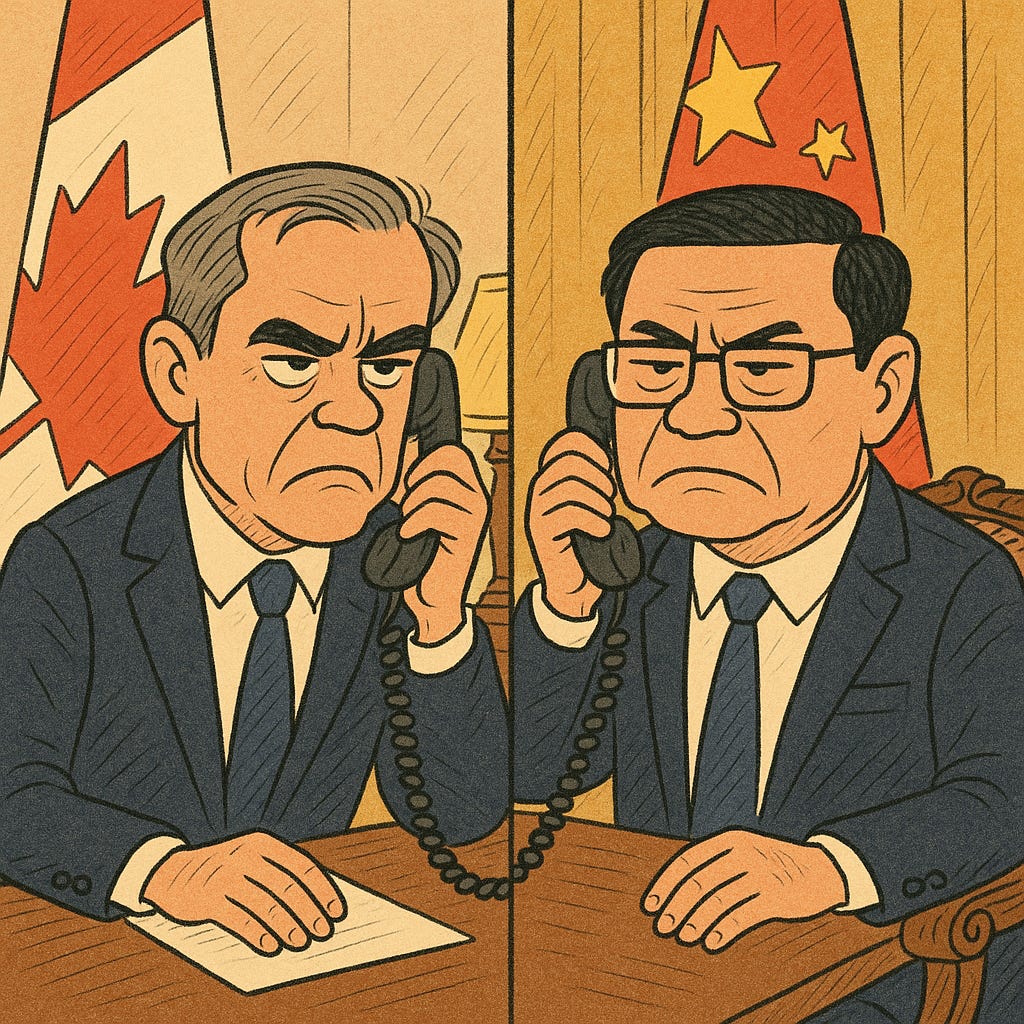
Canada and China are talking again at senior levels
Prime Minister Mark Carney and Premier Li Qiang recently agreed to “regularize communication channels” but relations remain strained by unresolved grievances and disagreements, a widening divergence in interests and values, and hostile CCP policies. For Canada, it’s not a reset, it’s a cautious recalibration.
But the CCP’s hostile behaviour means that for Canada, this is a wary recalibration, not a reset in relations
Canada sees the CCP as a threat because of its massive support for Russia’s invasion of Ukraine, regional aggression, cyberattacks, espionage, transnational repression, mercantilist economic policies, “wolf warrior” diplomacy, subversive political interference, illegal overseas police stations, sanctions on human rights advocates, executions of some Canadians and refusals to grant consular access to others, and harassment of members of the Chinese diaspora. I could go on…
China wants access to Canada’s market—on its terms
China wants Canada to take a short-term, transactional approach and forget about values and national security. But for Canada, values ARE a core interest because they define a common identity that binds together a diverse population. Internationally, those values are actualized through liberal norms, laws and institutions that help protect smaller countries like Canada from aggression and coercion by larger powers such as China.
Electric Vehicles are central to the latest trade dispute
Electric Vehicles are the latest battleground. After Canada blocked an incoming wave of Chinese EVs with 100% tariffs, China hit back against Canadian agri-food products. I think China wants to take a big share of Canada’s auto sector and from there reach the US market. Whether it’s through imports or assembly plants, that would decimate the Canadian auto sector and stifle a domestic infant industry. So Canada should maintain its tariffs.
Letting Chinese producers dominate EVs in Canada would lock the country into a dependent role as a supplier of energy + commodities & absorber of China’s manufacturing overcapacity. It could also create major cybersecurity vulnerabilities. EV’s are like giant smartphones on wheels. If Canada doesn’t let Huawei build its telecom infrastructure, why allow BYD to make its connected vehicles?
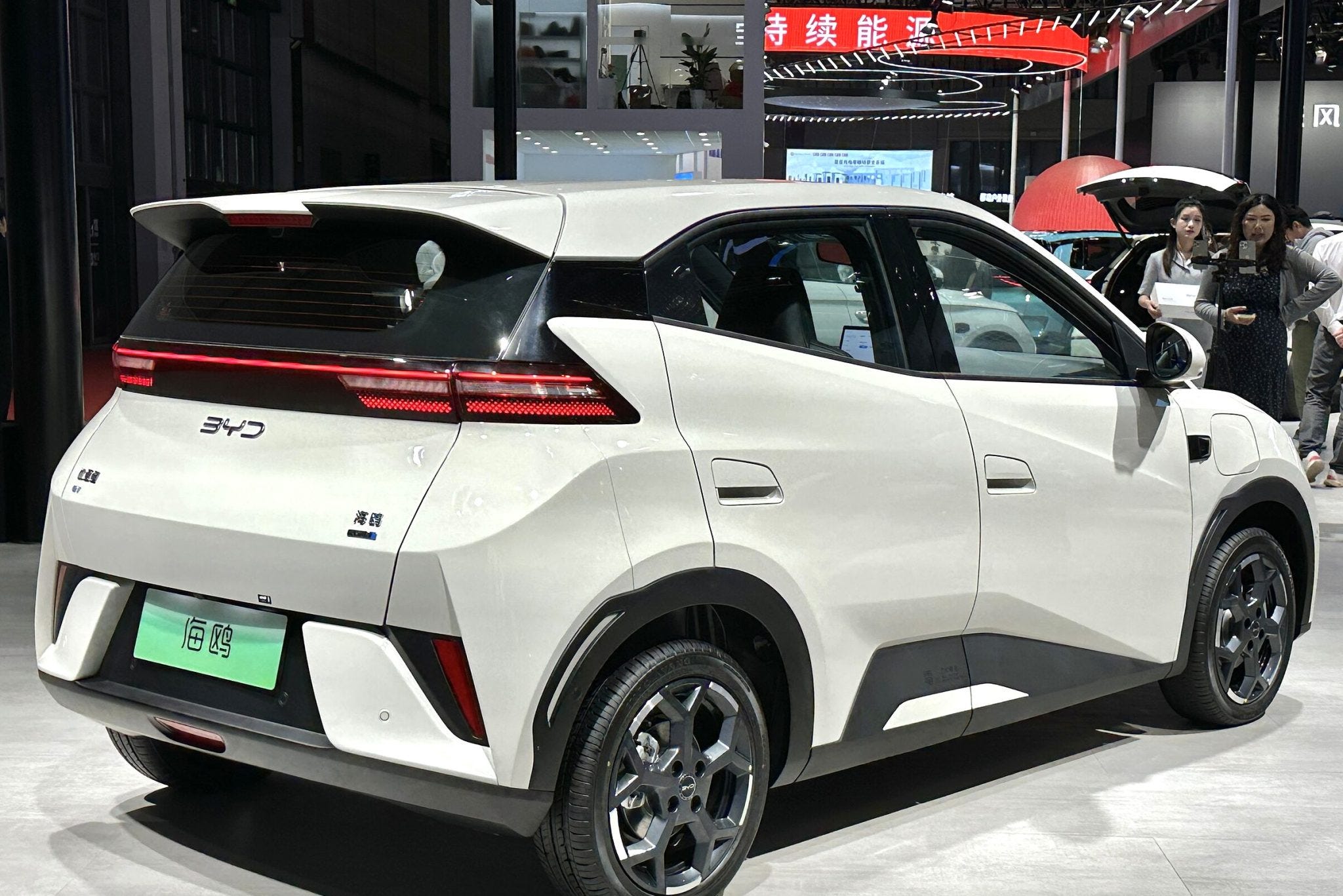
The Chinese-built BYD Seagull electric vehicle. Photo: JACD/Wikimedia Commons.
As of 2025, the growing realization that China poses a major threat to Canada’s national and economic security has remolded the relationship into one characterized by caution, distrust and recalibration for Canadians.
Recently, Chinese Ambassador to Canada Wang Di and his diplomats have been re-engaging Canadian media and thought leaders with conciliatory, gaslighting messages that are jarringly at odds with Beijing’s actual behaviour. “Whether it is the tariffs imposed on Canada by other countries or the tariffs Canada imposes on China, they are all unfair”, Ambassador Wang argued in a recent interview. “Let business be business”, he urged – inviting us to imagining a fantasy world in which politics has no influence on Chinese firms and Canada welcomes further deindustrialization.
Guancha columnist Sun Bo writes that Canada and China should resume normal trade relations “to achieve mutual benefit and win-win outcomes”. But normal trade is unfeasible because China’s economic policies are far from normal, and “win-win” has long been a joke that China wins twice.
Canada should maintain its tariffs and diversify its trade to more reliable partners
The smart play? Trump should stop giving American allies like Canada a hard time and instead join CPTPP and agree on a common level of North American and European tariffs on Chinese exports. (Oh to dream!)
For a deeper dive, check out the full article. China hands who want to see the original Chinese quotations from my research sources should read the China Trends version.
My thanks to the editors of China Trends for the opportunity to explore this topic, to the CIC for bringing it to a Canadian audience, and to Jonathan Landreth, Patricia Xavier and Joe Widacki for help researching and writing it.
So how do you think Canada should manage its relations with China going forward? Join the conversation. I welcome your thoughts.
Michael, you are analyzing Geopolitics through a rear-view mirror of "Values." The windshield shows a future defined by "Physics."
I respect your personal history, but your economic prescription for Canada is suffering from "System A Nostalgia." You argue that integrating with China is a "Devil's Bargain" that sacrifices manufacturing for resource exports. The ChinArb Reality Check: That is not a bargain; that is Gravity.
1. The "Industrial Fantasy" of Canada You fear that BYD will "decimate" Canada’s auto sector. Newsflash: Canada does not have an autonomous auto sector. It has "Branch Plants" for Detroit. Canada is a high-cost, low-efficiency jurisdiction that survives solely on the USMCA umbrella.
System B (China) offers efficient, deflationary hardware (EVs).
System A (US) offers inflationary protectionism. By blocking BYD, you are not saving Canadian industry; you are taxing Canadian consumers to protect the profit margins of General Motors. You are choosing Inflation over Evolution.
2. The "Resource Colony" Fate You warn against becoming an "absorber of China’s manufacturing." But look at the map. Canada is geographically vast, resource-rich, and population-sparse. In the Great Bifurcation, Canada’s thermodynamic destiny is to be a "Mine":
Scenario A (US Orbit): You are the resource colony for Fortress America, paid in depreciating USD.
Scenario B (China Orbit): You are the resource supplier for the Global Factory, paid in cheap goods. Yiran He is right in his bluntness: "Make a deal or become the 51st state." Actually, it’s worse. You are already the 51st State for Security, but you want to be a Sovereign Nation for Trade. The physics of 2026 do not allow this superposition.
3. BYD in Alberta? (Response to Yiran He) Yiran, your idea of a "BYD factory in Alberta" is logically sound but physically impossible. Not because of Kovrig’s "National Security" fears, but because of Supply Chain Density. You cannot transplant a System B orchid (BYD) into the frozen soil of System A (Canada). The local supply chain is too slow, too expensive, and too unionized. BYD won't build in Alberta. They will build in Mexico and truck it north. That is the path of least resistance.
Michael, the tragedy of Canada isn't that it's being bullied by China. It's that in a world of Titans, it thinks it's a Player, when the math says it's just the Board.
Most people do NOT understand the danger that Chinese EVs pose. They are rolling computers, scooping up massive amounts of data, and they are always connected. We are in an AI arms race. I drive a Tesla and will only drive a Tesla - and this is one reason why.